Moritz Klein Instruments
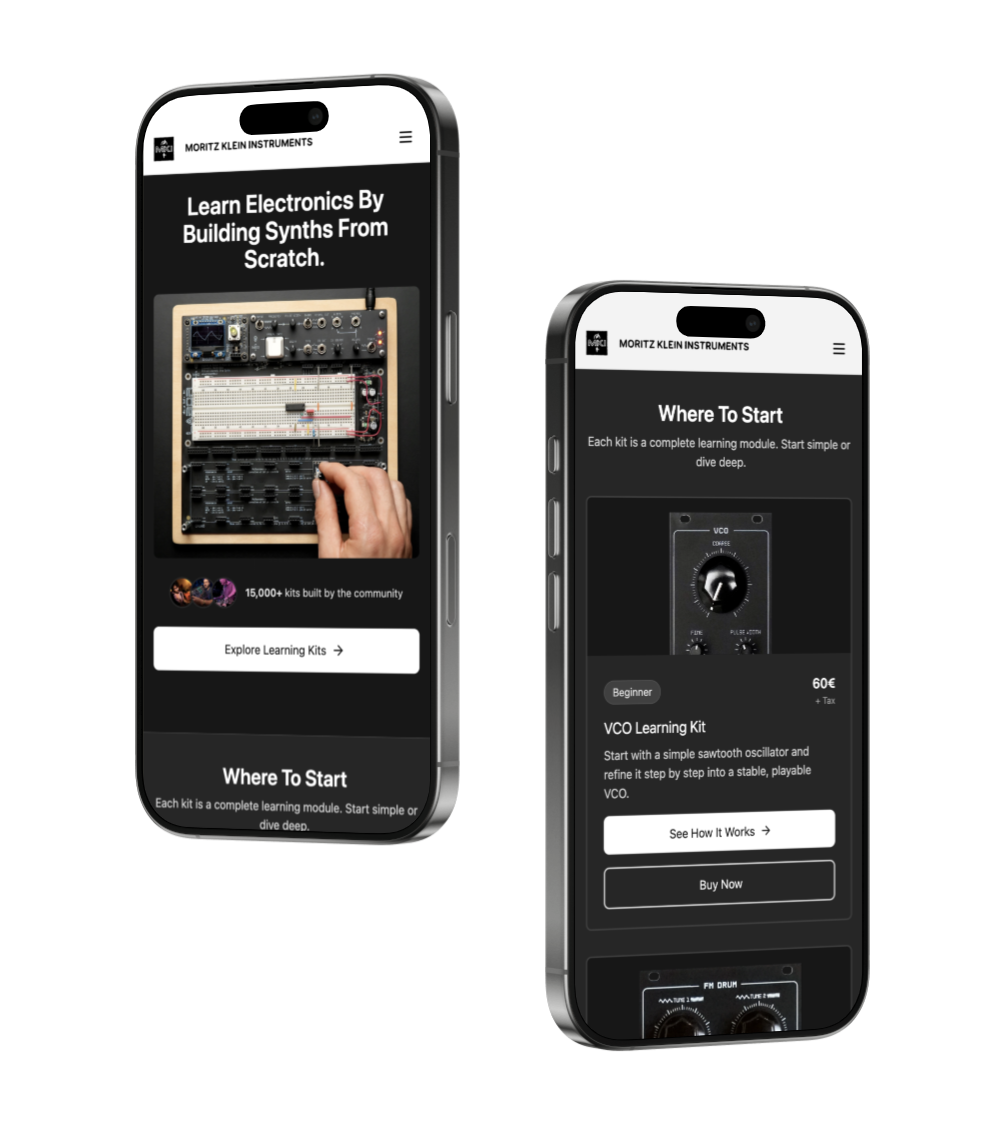
Customers weren't buying hardware. They were buying confidence.
Moritz Klein Instruments (in collaboration with Erica Synths) creates educational DIY synthesizer kits that teach analog circuit design through hands-on building. Despite strong YouTube traction and an engaged community, conversion friction persisted on product pages.
Through qualitative research and A/B testing, the core tension became clear: How do you sell learning without overwhelming beginners or boring experienced builders?
[Overview]
Moritz Klein Instruments creates educational DIY synthesizer kits in collaboration with Erica Synths. Despite strong YouTube traction and an engaged community, conversion friction persisted on product pages. Research revealed that users needed reassurance, not features.
[Objectives]
- Understand why interested users hesitate to purchase
- Identify the role of confidence and perceived risk in buying decisions
- Test an education-centered product page against the original
- Deliver actionable recommendations for product framing
[Impact]
- Shifted product narrative from hardware to learning
- Increased purchase intent and confidence ratings
- Validated tier segmentation strategy
- Provided roadmap for future kit structuring and messaging
Research Approach
15 moderated remote interviews with a mix of buyers, non-buyers, and different skill levels. Each participant reviewed the existing product page, a revised education-centered product page, and a direct A/B comparison.
Think-aloud testing of two product page versions (Old vs. Education-Focused Revision) with embedded purchase intent ratings (Likert 1–7) and thematic coding across confidence, clarity, motivation, and perceived risk.
Qualitative & comparative testing
Moderated remote interviews — 15 sessions with buyers, non-buyers, and participants across different skill levels to capture diverse perspectives.
Think-aloud A/B testing — Participants reviewed two product page versions side by side, revealing real-time perceptions and hesitations.
Purchase intent measurement — Embedded Likert scale ratings (1–7) to quantify confidence shifts between page versions.
Thematic analysis — Coding across four dimensions: confidence, clarity, motivation, and perceived risk.
People buy learning, not hardware
Participants consistently reframed the product. Not: "I want a VCO module." But: "I want to understand how oscillators actually work."
When learning outcomes were explicitly listed, purchase intent increased. Clear educational framing reduced hesitation significantly.
"The second version feels like a real learning kit." "Now I understand what I would actually gain."
Price is a proxy for risk
€60 was rarely described as "too expensive." Instead, users asked: Will I be able to finish this? What if I fail? Do I have the time? Is this too advanced for me?
The barrier wasn't cost — it was self-doubt. The original page unintentionally amplified that doubt through lack of explicit skill-level definition, dense information structure, and warning-style support messaging.
Beginner-friendly must be defined, not declared
Simply labeling a kit "Beginner-friendly" did not increase confidence. Confidence increased only when "No prior electronics or soldering required" was explicitly stated, learning steps were outlined progressively, and mistakes were framed as part of the process.
Psychological safety turned out to be a conversion lever.
Breadboards signal cognitive load
Even experienced hobbyists described breadboarding as overwhelming, error-prone, and mentally demanding. Structured PCB-based builds felt safer and more achievable.
This reframed how the optional Labor platform should be positioned: not as an accessory — but as a cognitive support tool.
What changed in the new product page
The revised version introduced a prominent "What You'll Learn" section above the fold, an explicit beginner definition, bullet-pointed learning outcomes, a cleaner visual hierarchy, clearer differentiation between kit tiers, and supportive troubleshooting framing.
Participants repeatedly described the new page as clearer, more educational, more structured, and more motivating.
Measurable impact across all segments
Improved comprehension — across all user segments.
Increased confidence ratings — participants felt more capable of completing the build.
Stronger perceived educational value — the kit was seen as a learning platform, not just a product.
Higher reported purchase intent — in-session ratings shifted significantly.
Strategic recommendations
1. Lead with learning outcomes, not features. Users respond to what they will understand, not what they will receive.
2. Normalize mistakes and troubleshooting. Framing errors as part of the process reduces fear of failure.
3. Introduce lower-commitment entry tiers. Learning-only content offers a stepping stone for hesitant users.
4. Clarify time expectations. Reducing effort anxiety by setting realistic time frames.
5. Position kits as reusable learning platforms. Not single-use builds, but tools for ongoing discovery.
From "Build your own module" to "Learn analog synthesizer design step by step"
The research shifted the entire product narrative. This reframing strengthened beginner confidence, validated tier segmentation strategy, identified price perception as risk-based rather than cost-based, and provided a roadmap for future kit structuring and messaging.